Habitat
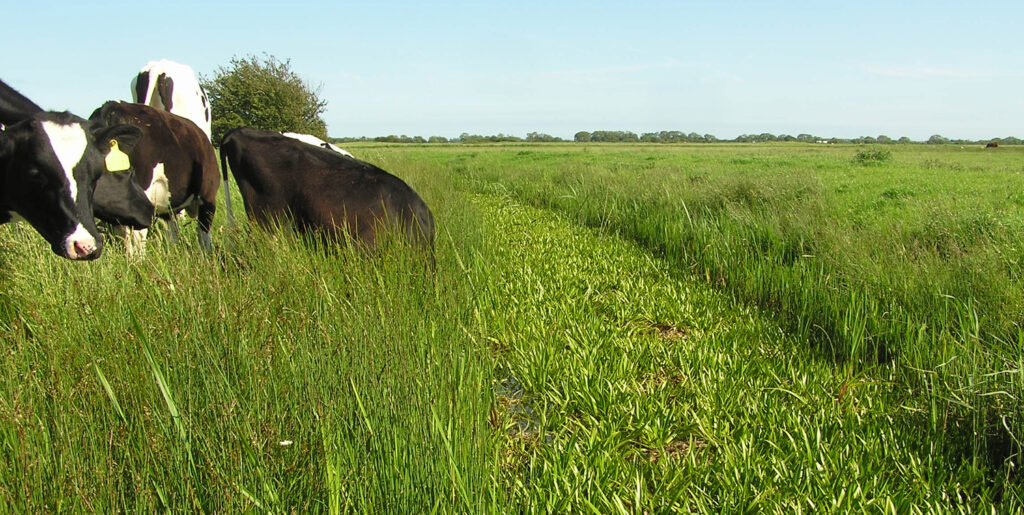
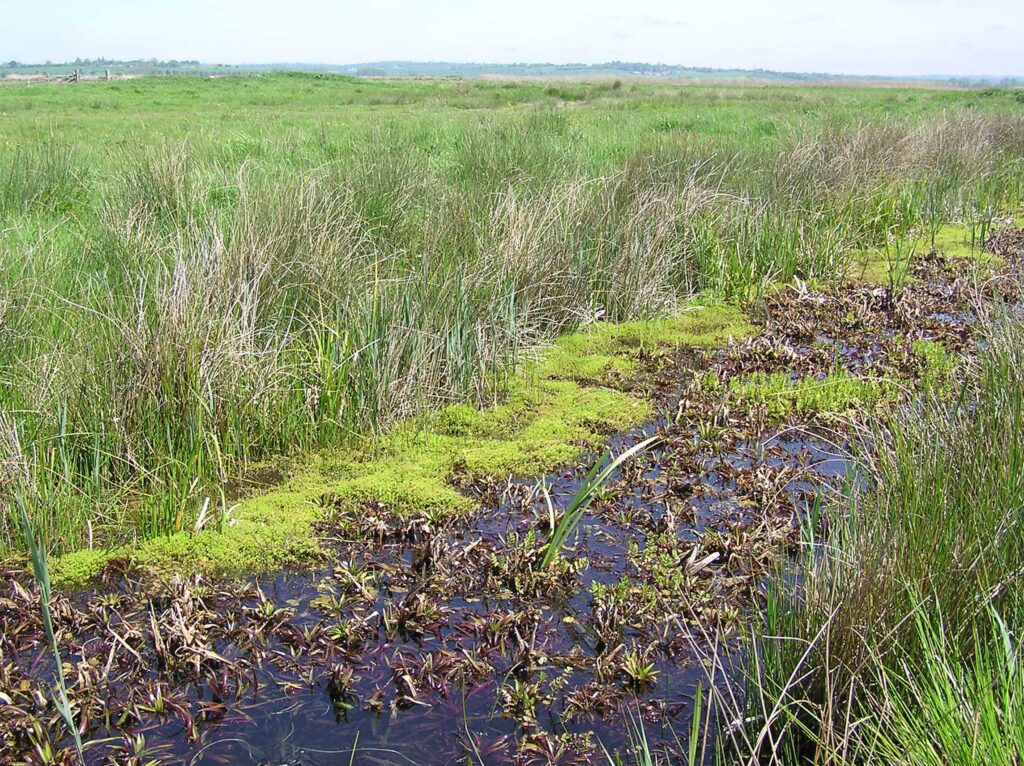
The Pevensey Levels is a low-lying area of agricultural land between the towns of Eastbourne and Bexhill in East Sussex, on the south coast of England. It comprises one of the largest continuous lowland wet grazing systems in south-east England. Despite extensive arable conversion, around 3,500 ha of grazing meadow remain, intersected by a complex network of ditches. The aquatic communities supported by these ditches include 68% of British aquatic plant species and many nationally rare and threatened invertebrates. The national and international importance of the area is reflected in its designation as an SSSI and RAMSAR site. Some of the best habitat (181.6 ha) is protected as a National Nature Reserve (NNR), 130.2 ha of which is managed by the Sussex Wildlife Trust (SWT). Although the Pevensey habitat is very different from that at Redgrave and Lopham Fen they share important characteristics in common with one another and with most western European D. plantarius sites. Both are lowland wetlands fed by neutral to alkaline, base-rich water, with open water areas persisting throughout the year. The structure of the emergent aquatic, and riparian, vegetation is critical and more important than its species composition (Smith 2000). The requirement for stiff-leaved, emergent vegetation to support the spider’s nursery webs, which is met primarily by Cladium mariscus at Redgrave and Lopham Fen, is fulfilled on the Pevensey Levels by a range of emergent marginal species such as Carex pseudocyperus and, in places, by the stiff leaves of the floating rosettes of Stratiotes aloides.
Conservation
Anecdotal evidence suggests that the Dolomedes population on the Levels was known to local people well before its identification as D. plantarius in 1988 (Kirby 1990). English Nature (now Natural England) commissioned a large-scale survey to assess the spider’s range and abundance in 1990 (Jones 1992). This survey, of ca 90 km of ditches throughout the SSSI and in adjacent areas, revealed a very extensive population. In the areas of best habitat, primarily on the lower-lying, central gravity-drained marshes, densities were often very high with nursery webs averaging one per 2m of bank. Away from this core area, the marshes are pump-drained and more fragmented by conversion to arable agriculture – around 20% by 1990 – the spider population also appeared to be very fragmented and abundance was generally lower. On the basis of nursery web counts, the total adult female population was estimated to be in the order of 3,000 at a time when the Redgrave and Lopham Fen population was thought to have, at best, only tens of adult females.
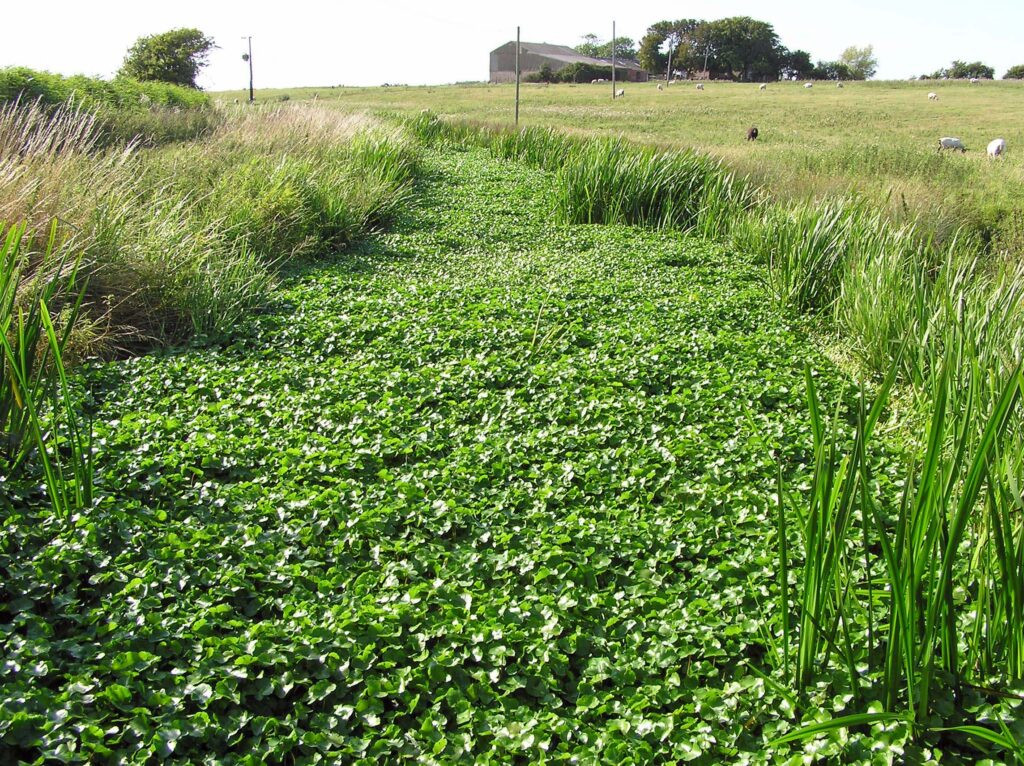
Although the Pevensey population was much larger than that at Redgrave and Lopham Fen in 1990, it is widely considered that habitat quality on the Levels had declined substantially during the previous fifty years. Drainage schemes implemented in the 1960s and 1970s substantially reduced water levels and allowed further conversion of pasture to arable. The wetland area was reduced by loss of ditches to deliberate infilling and to drying out as a result of low water levels and colonisation by Common Reed Phragmites australis and scrub. Water quality also declined and some of the main channels became eutrophic. A further threat to the rich species assemblages of the ditches has come from dramatic increases in the populations of invasive non-native plant species (INNS), and particularly New Zealand Pigmyweed Crassula helmsii and Floating Pennywort Hydrocotyle ranunculoides. A wide range of conservation measures to mitigate these impacts have been put in place since the 1990s, including a series of agri-ennvironment schemes, Water Level Management Plans and, least successfully to-date, control measures for the INNS.
Despite the national importance of the Pevensey Levels population, and the changing conservation context on the Levels, no systematic monitoring was put in place after the 1990 survey. In recent decades, several new outliers of the D. plantarius population have been discovered, mostly through casual recording and impact assessments for planning developments. These include one at Combe Valley Countryside Park, in a neighbouring catchment, separated from the Pevensey Levels by the extensive urban sprawl of Bexhill. Survey and research was undertaken in 2025 to assess whether these outliers represented a recent increase in range of the core population, previous undiscovered, isolated fragments, or the residue of very long separated populations. Natural England’s Species Recovery Programme, with help from the local Internal Drainage Board through the Water Management Alliance, funded a reassessment of the extent of the population togther with genetic analysis of the core and outlying populations, in 2025 (Heeney 2026, Maka 2026).
An interactive report on the 2025 survey can be viewed at this link. The written version of this report and the report on the gentics work are available for download in the references at the foot of this page.
The Future
Climate change models predict that the Pevensey Levels will become much less suitable for D. plantarius over the next 50 years (Leroy et al. 2013, Milano et al. 2020). However, potentially on a much shorter time-scale, sea level rise and an increasing incidence of extreme high tides must be seen as a threat to this population, much of which is on low-lying marshes reclaimed from salt marsh in the Middle Ages.
To monitor the responses of this nationally and internationally important D. plantarius population to changes in management of the Pevensey Levels, and to our rapidly changing climate, a systematic, long-term, monitoring programme is urgently needed.
References
Heeney, W. 2026a. Fen Raft Spider – Pevensey Levels 2026. Unpublished report to Natural England.
Heeney, W. 2026b. Fen Raft Spider – Pevensey Levels 2025. Interactive report to Natural England:
Kirby P. 1990 Dolomedes plantarius in East Sussex, Newsletter of the British Arachnological Society 58: 18.
Leroy, B., Paschetta, M., Canard, A., Bakkenes, M., Isaia, M. & Ysnel, F. 2013. First assessment of effects of global change on threatened spiders: potential impacts on Dolomedes plantarius (Clerck) and its conservation plans. Biological Conservation 161: 155–163. DOI:10.1016/j.biocon.2013.03.022
Milano, F, Cardoso, P, Mammolo, S., Smith, H. & Isaia, M. 2022. Trends in habitat suitability and conservation status of aquatic spiders in Europe. Biological Conservation 275 [109767]. https://doi.org/10.1016/j.biocon.2022.109767.