Discovery of the remnant Dolomedes plantarius populations
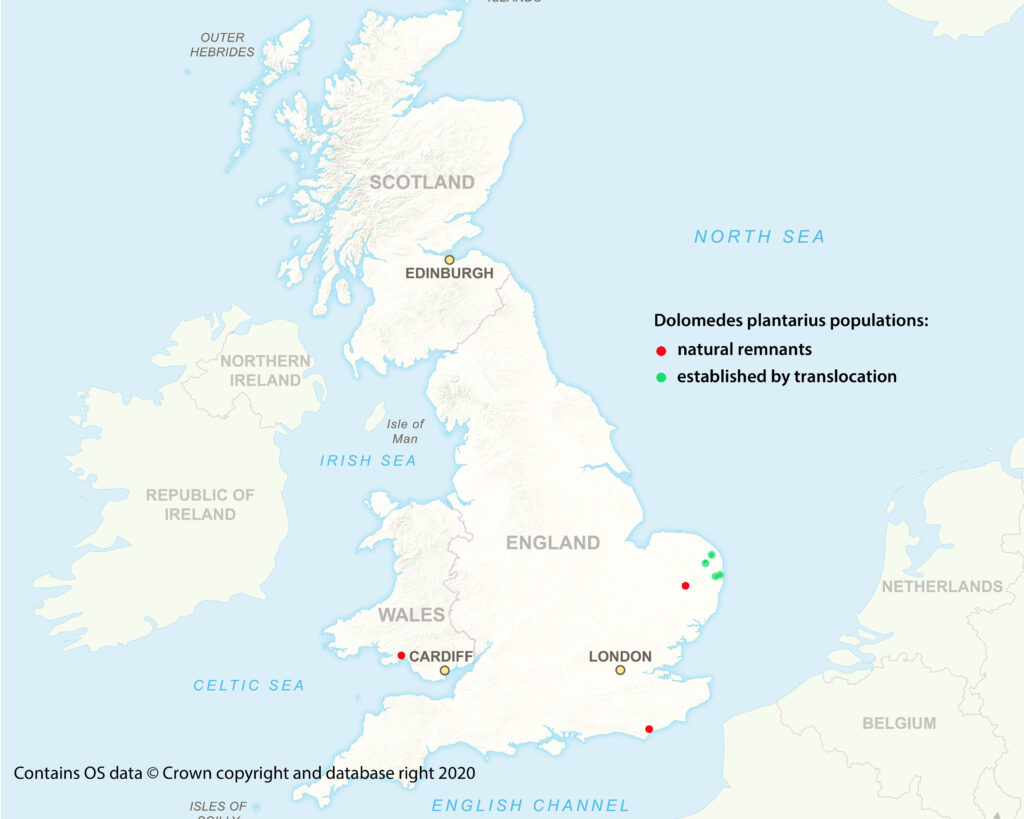
Dolomedes plantarius was not formally described from Britain until 1956 when the late and eminent arachnologist Dr Eric Duffey found it around the margins of peat pools at Redgrave and Lopham Fen, Britain’s largest remaining valley fen at the source of the River Waveney on the Norfolk/Suffolk border (Duffey 1958). Fortuitously, his initial discovery was of a female that entirely lacked a lateral band, alerting him to the possibility that this was D. plantarius rather than the commoner D. fimbriatus, which is is not dimorphic for this feature. Click here to read more about the Redgrave and Lopham Fen population.
It was not until 1988 that a second population was identified, 180km away, when Peter Kirby identified D. plantarius from grazing marsh ditches on the Pevensey Levels in East Sussex (Kirby 1990). This population had been known to biologists for several years but it was assumed to be D. fimbriatus. It had been known to local people for much longer and, in the 1950s, was reported to be common in the areas in which it is most still abundant (Mike Clarke, pers. comm). Click here to read more about the Pevensey Levels population.
The third UK population was first identified in 2003 on a disused canal near Swansea, South Wales, by local naturalist Mike Clark. Immature Dolomedes found on the near-by Crymlyn Bog National Nature Reserve were subsequently also identified as D. plantarius. Just as on the Pevensey Levels, this population was already known but thought to be D. fimbriatus: it had been discovered by David Woodfall together with late and great environmental campaigner Andrew Lees in 1977, but the record was never verified. Click here to read more about the populations in the Crymlyn Bog area.
The lack of reliable and verified historical records for D. plantarius in Britain makes it impossible either to assess reliably the extent of the species’ decline, or account for its present highly disjunct distribution. However, its extreme rarity is entirely consistent with the well-documented loss and degradation of wetlands in general, and of both lowland fens, and grazing marsh ditch systems, in particular. In addition, although verifiable historical records are lacking, a gathering body of evidence from the literature suggests strongly that this species was formerly present in areas beyond its current strongholds (see Historical populations, below).
The new populations
As part of the long-term programme to prevent extinction and recover the fortunes of D. plantarius in Britain, four new populations were established by translocation between 2010 and 2015. Over the following decade these not only established well within the nature reserve sites to which they were introduced, but also expanded their ranges beyond the boundaries of these sites and, increasingly, further afield to other resotored grazing marsh ditch systems within the Norfolk and Suffolk Broads. Click here to read about the translocation programme.
Historical populations
The current highly disjunct distribution of the remnant populations of D. plantarius, in three of Britain’s most intact and biodiverse lowland wetland areas, suggests strongly that it must formerly have been much more widespread. Although Duffey’s 1956 record from Redgrave and Lopham Fen is the first verified GB record, and no adequately labelled specimens have yet been found in historical collections that definitively associate this species with other British locations, there is growing evidence of records of Dolomedes from locations that would formerly have had extensive areas of ideal habitat. These include the Cambridgeshire fens and the Norfolk grazing marsh ditches. But because the separation of D. plantarius and D. fimbriatus was not widely accepted until the 1930s, all early records were identified as D. fimbriatus. Although investigation of some of these areas for Dolomedes might still have been profitable at that time, British arachnologists of the era dismissed the old reports as likely misidentifications of the large lycosid Pirata piscatorius.However, descriptions like that by the well-know Victorian naturalist, the Rev. Leonard Jenyns, of ‘this fine species, sometimes measuring in the body an inch in length is not uncommon in the fen, and occassionally in ponds in other places such as the pond in the Kitchen Garden at Wilbrham Temple’ are undoubtedly of Dolomedes. The sedge fens of the East Anglain Fen basin where they originate provided ideal Dolomdes plantarius habitat – and the monastic fish pond at Wilbraham Temple (pictured in this article in 1929) is analagous to the monastic carp ponds on which the species is sometimes found in continental Europe.
Unless well-labelled collection specimens emerge, it is likely that we will never be able to move beyond informed speculation about the previous distribution of D. plantarius in Britain. The many and diverse reasons for this, and the historical evidence available (e.g. see Dawson 2020 & Smith 2018, 2020), are important to the conservation case (please contact me if you are unable to obtain any of these articles, or find any historical referecnes that may refer to this species).
References
Dawson, I. 2020. Dolomedes in Cambridgeshire. Newsletter of the British Arachnological Society, 148: 8-11.
Duffey, E. 1958. Dolomedes plantarius Clerk, a spider new to Britain, found in the upper Waveney Valley. Transactions of the Norfolk and Norwich Naturalist’s Society 18: 1-5.
Kirby, P. 1990. Dolomedes plantarius in East Sussex, Newsletter of the British Arachnological Society 58: 18.
Smith, H. 2020. The Fen Raft Spider: from unknown past to uncertain future. British Wildlife 32: 98-109.
Smith, H. 2018: Hanging by a thread: Norfolk’s rarest spiders. Transactions of the Norfolk and Norwich Naturalists’ Society 51: 1–14.